Robotic Prostatectomy
Robotic radical prostatectomy for prostate cancer with focus on cancer control, continence preservation and functional outcomes.

About Robotic Radical Prostatectomy
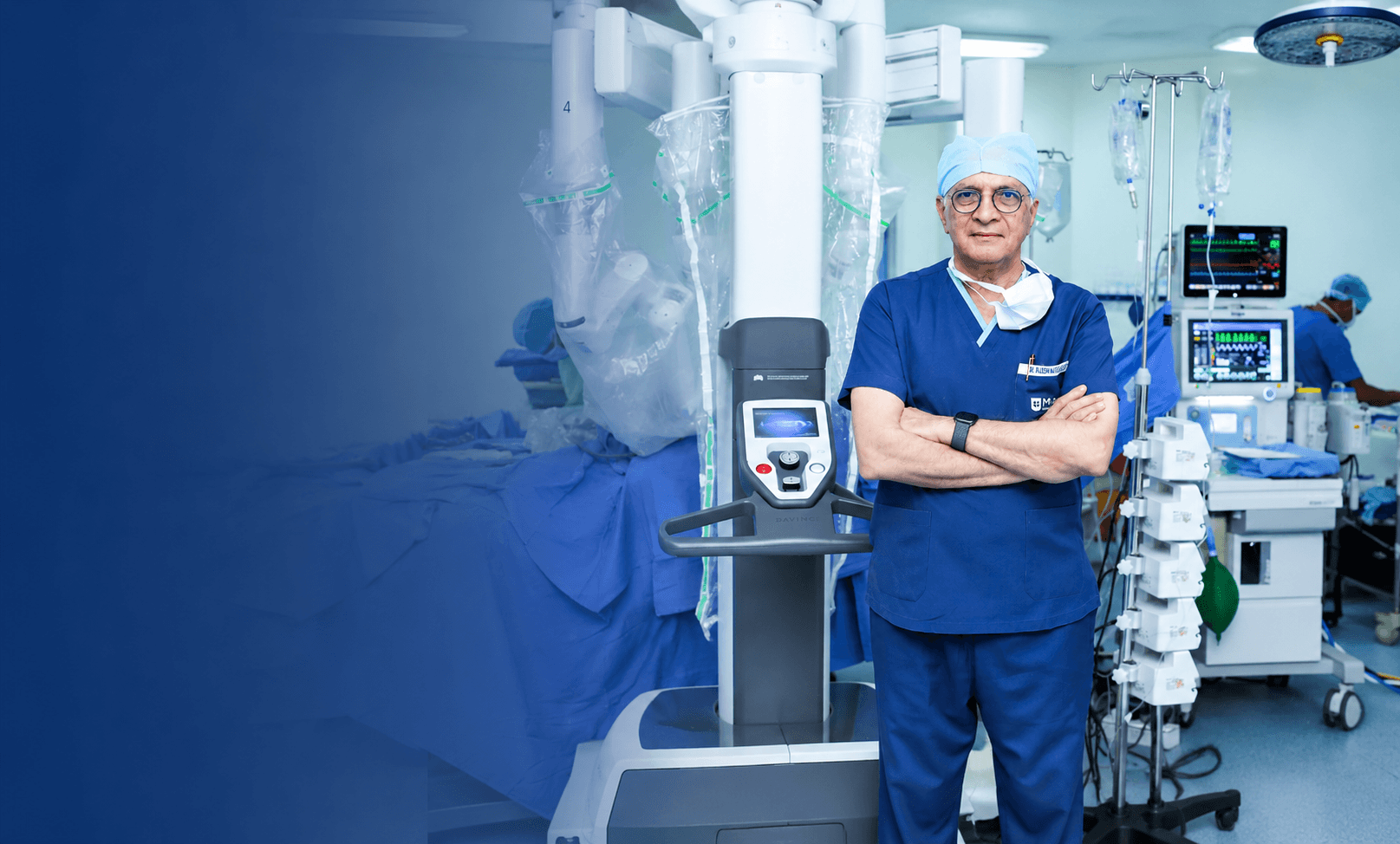
Robotic radical prostatectomy is the complete removal of the prostate and seminal vesicles using the da Vinci system, through several small incisions. For localised prostate cancer it offers cure in appropriately selected patients, with less blood loss and a faster return to normal activity than open surgery.
The operation is judged on three outcomes together — cancer clearance, urinary continence, and erectile function. Nerve-sparing technique is used wherever it is oncologically safe, and that judgement is made tumour by tumour, guided by MRI, biopsy findings and what is seen during surgery.
- Pelvic lymph node dissection where the risk of nodal involvement warrants it
- Nerve-sparing calibrated to disease extent rather than applied indiscriminately
- Structured pelvic floor rehabilitation from an early stage after surgery
Who May Benefit
Robotic radical prostatectomy may be appropriate if you:
- Have localised prostate cancer confined to the prostate, and are fit for surgery
- Have intermediate- or high-risk disease where surgery offers the best chance of cure
- Have low-risk disease that has progressed while on active surveillance
- Have a reasonable life expectancy such that treating the cancer is likely to benefit you
- Prefer surgery to radiotherapy after discussing both, and want definitive pathology of the whole prostate
- Have locally advanced disease where surgery forms part of a planned multimodal approach
When This May Not Be the Right Option
- Metastatic disease, where systemic therapy takes precedence
- Significant heart or lung disease making prolonged anaesthesia unsafe
- Low-risk cancer well suited to active surveillance, where surgery may cause more harm than the cancer would
- Patients who would prefer to avoid any risk to continence and are suitable candidates for radiotherapy
The Procedure and the Alternatives
What the Operation Involves
Surgery is performed under general anaesthesia and typically takes two to three hours. The prostate and seminal vesicles are removed, the bladder is rejoined to the urethra, and a catheter is left in place. Pelvic lymph nodes are removed in the same operation where indicated. Most patients stay in hospital for one to two days, with the catheter removed after about a week.
Retzius-Sparing Approach
An approach that preserves the anterior structures around the bladder, associated in published series with earlier return of urinary continence. Suitability depends on tumour location and prostate anatomy.
Alternatives to Surgery
- Radiotherapy — external beam or brachytherapy, with comparable cancer control in many risk groups and a different side-effect profile
- Active surveillance — for low-risk and selected favourable intermediate-risk disease
- Focal therapy or HIFU — for selected localised, unilateral tumours
- Hormonal therapy — usually combined with radiotherapy rather than used alone in localised disease
Investigations Usually Required
- PSA — with previous values where available, to understand the trend
- Multiparametric MRI of the prostate — PI-RADS reported; assesses tumour location, capsular contact and seminal vesicle involvement, which directly informs nerve-sparing planning
- Prostate biopsy histopathology — Gleason score and Grade Group, number and location of positive cores
- PSMA PET-CT or bone scan with CT — staging for intermediate- and high-risk disease
- Pre-anaesthetic assessment — blood counts, kidney and liver function, blood sugar, ECG, chest imaging, and cardiology review where indicated
- Baseline continence and erectile function assessment — documented before surgery so that recovery can be measured honestly against your own starting point
Important Limitations and Risks
- Urinary incontinence. Some leakage is usual immediately after catheter removal. Most men improve substantially over three to twelve months, but a minority have persistent leakage requiring pads or further intervention.
- Erectile dysfunction. Even with bilateral nerve-sparing, erections take months to recover and may not return to their previous level. Where nerve-sparing is not oncologically safe, erectile dysfunction is likely to be permanent. Age and pre-operative function are the strongest predictors.
- Loss of ejaculation is permanent in all cases, and fertility is affected. Sperm banking should be discussed before surgery if this matters to you.
- Positive surgical margins occur in a proportion of cases, particularly with locally advanced disease, and may lead to a recommendation for additional radiotherapy.
- Biochemical recurrence — PSA can rise again after surgery. Surgery is not a guarantee of cure, and further treatment may be needed.
- Surgical risks — bleeding, infection, injury to adjacent structures, lymphocele after node dissection, venous thromboembolism, and rarely conversion to open surgery.
- Robotic assistance does not change the cancer. It is a means of performing the operation with less trauma; it does not by itself improve the chance of cure over well-performed open surgery.
What a Consultation Involves
A surgical consultation usually takes 30 to 45 minutes and covers:
- Review of your diagnosis — PSA, MRI and biopsy, and what your risk category means
- Whether surgery is the right choice for you — including an honest comparison with radiotherapy and, where relevant, surveillance
- Nerve-sparing planning — what is realistic in your case, based on where the tumour sits
- Expected recovery — hospital stay, catheter duration, return to work and activity, and the realistic timeline for continence and potency
- Your baseline function — documented so that recovery can be tracked against it
- Fitness for surgery — and any pre-operative optimisation needed
- Your questions — with time to consider before committing to a date
Bringing your partner is encouraged, particularly for the discussion about sexual function.
Supporting References
Each reference opens on PubMed in a new tab.
- Abdollah F, Arora S, Jindal T, Ahlawat R, et al. Utilization of pelvic lymph node dissection in patients undergoing robot-assisted radical prostatectomy in India versus the United States. Indian J Cancer. 2017;54(2):421–5. PMID: 29469070
- Batra V, Gautam G, Jaipuria J, Suryavanshi M, Khera R, Ahlawat R. Predictive factors for lymph node positivity in patients undergoing extended pelvic lymphadenectomy during robot assisted radical prostatectomy. Indian J Urol. 2015;31(3):217–22. PMID: 26166965
- Ahmed K, Khan R, Mottrie A, Ahlawat R, et al. Development of a standardised training curriculum for robotic surgery: a consensus statement from an international multidisciplinary group of experts. BJU Int. 2015;116(1):93–101. PMID: 25359658
- European Association of Urology. Guidelines on Prostate Cancer. EAU–EANM–ESTRO–ESUR–ISUP–SIOG, current edition.
This page was last medically reviewed by Dr. Rajesh K. Ahlawat in August 2026. It is general information, not medical advice. Please consult a qualified specialist about your own situation.